How to Manage Cash Flow for Small Business (Simple System)
Cash flow is the lifeblood of every small business. It determines whether you can pay bills, meet payroll, invest in growth, and stay in business during slow seasons. Yet many small business owners struggle not because they lack customers — but because they fail to manage cash flow effectively.
This comprehensive yet practical guide will walk you through a simple, proven system to manage cash flow, backed by real financial logic and best practices. We’ll explain key concepts, actionable strategies, tools to use, and mistakes to avoid — all with the clarity that helps you actually implement better cash management today.
What Is Cash Flow (and Why It Matters)
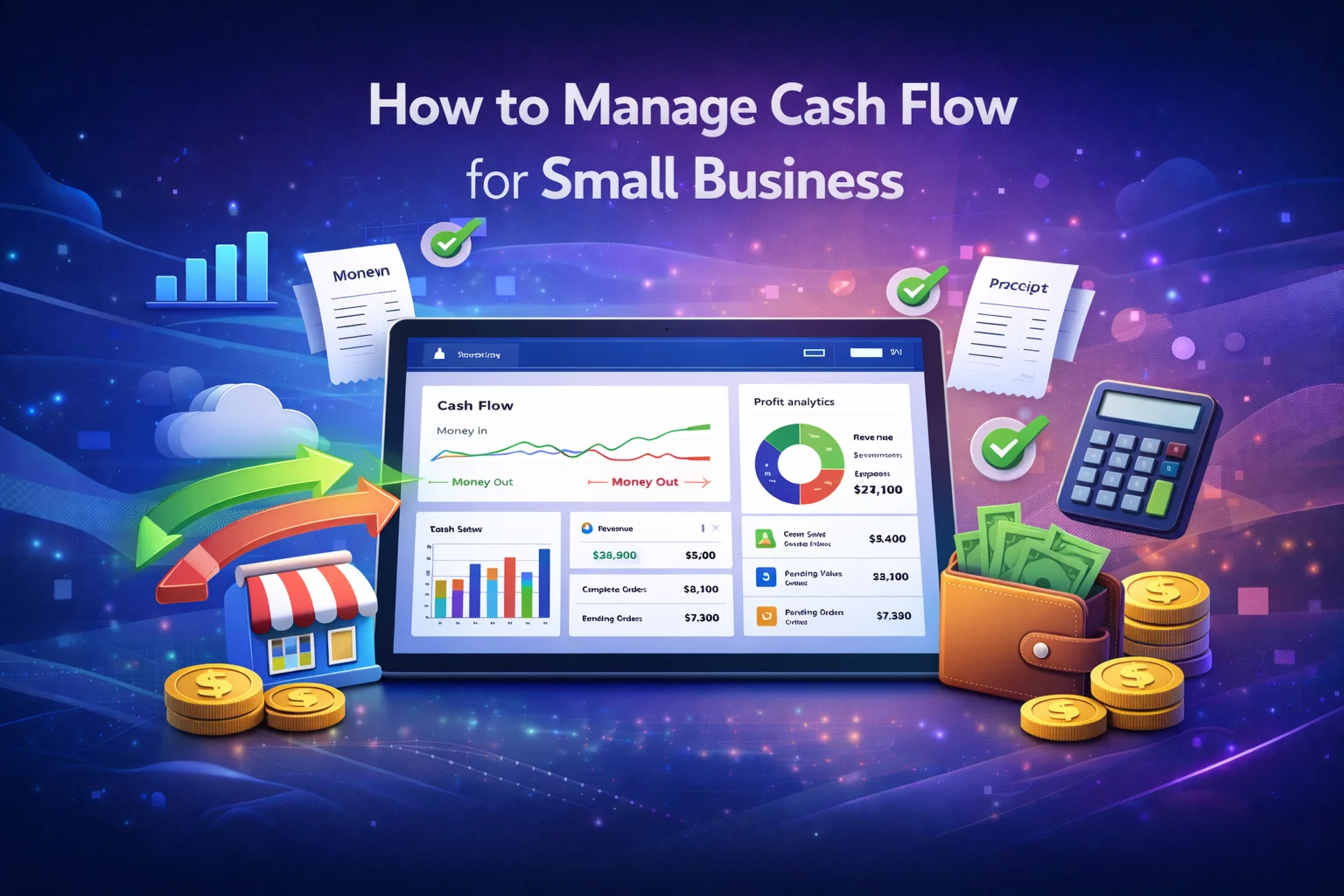
Cash flow refers to the movement of money into and out of your business — not just your profits. It tracks your actual cash available at any given time.
Here’s the basic equation:
Cash Flow = Cash In – Cash Out
Where:
- Cash In = Customer payments, sales revenue, loans, investment
- Cash Out = Expenses, payroll, supplier payments, taxes
Cash flow is more important than profit in the short term because you can be profitable but still run out of cash. Many small businesses fail not due to lack of profit but due to poor cash flow management.
Cash Flow vs Profit: Why the Difference Matters
It’s easy to confuse cash flow with profit, but they are not the same:
| Cash Flow | Profit |
|---|---|
| Measures actual money available | Measures revenue minus expenses (accrual) |
| Affects your ability to pay bills now | Shows business health over a period |
| Includes timing differences (when cash arrives or leaves) | Does not include timing elements |
For example, you might sell $10,000 in services, but if only $4,000 is paid this month and the rest is on net‑30 terms, your profits might look strong — but your actual cash on hand may not be.
Why Small Businesses Struggle with Cash Flow
Common cash flow problems include:
- Late customer payments
- Poor invoicing systems
- Unanticipated expenses
- Inventory overstock
- Seasonal sales fluctuations
- Lack of cash flow forecasting
Understanding the root causes helps you build a system to prevent them.
A Simple Cash Flow Management System
Managing cash flow doesn’t have to be complicated. Below is a step‑by‑step system that combines planning, monitoring, and action to keep your cash flow healthy.
1. Create a Cash Flow Forecast
A cash flow forecast estimates your expected cash inflows and outflows over a future period — typically 12 months.
How to Create a Forecast
You can build a simple forecast in Excel or Google Sheets with:
Columns: Months
Rows:
- Beginning Cash Balance
- Cash Inflows (Sales, Accounts Receivable)
- Cash Outflows (Expenses, Payroll, Taxes)
- Net Cash Flow
- Ending Cash Balance
Example Cash Flow Forecast
| Month | Beginning Cash | Cash In | Cash Out | Net Cash Flow | Ending Cash |
|---|---|---|---|---|---|
| Jan | $20,000 | $30,000 | $35,000 | -$5,000 | $15,000 |
| Feb | $15,000 | $32,000 | $30,000 | +$2,000 | $17,000 |
| Mar | $17,000 | $28,000 | $27,000 | +$1,000 | $18,000 |
Forecasting helps you identify months where cash might be tight and plan accordingly.
2. Monitor Cash Daily or Weekly
Tracking cash flow only monthly is too late. Monitor it weekly — or even daily during critical periods.
Use these reports:
- Cash Position Report – How much cash you have now
- Accounts Receivable Aging – Who owes you money and when
- Accounts Payable Aging – What bills are due soon
Reviewing these regularly gives you real‑world visibility.
3. Accelerate Cash Inflows
Here are proven ways to speed up cash inflows:
✔ Invoice Quickly and Professionally
Delayed invoicing = delayed payment. Use an automated system like Xero to send invoices immediately when products are delivered or services completed.
✔ Offer Early‑Payment Incentives
Consider small discounts (e.g., 2% off if paid in 10 days) to encourage faster payments.
✔ Use Online Payments
Allow customers to pay with cards or ACH directly from invoices. Most accounting tools support integrations with Stripe, PayPal, or Square.
4. Control Cash Outflows
Keeping cash tight doesn’t mean neglecting operations — it means timing cash payments wisely.
✔ Negotiate Better Terms
Ask suppliers for net‑45 or net‑60 terms instead of net‑30. This gives you more time to hold cash before paying.
✔ Schedule Payments Strategically
Pay bills on the due date instead of immediately. Optimizing the timing prevents idle cash from leaving too early.
✔ Reduce Unnecessary Expenses
Review subscriptions and recurring charges quarterly. Cancel unused tools or downgrade plans.
5. Manage Your Accounts Receivable
Unpaid invoices are one of the biggest cash killers for small businesses.
Here’s a simple receivables management plan:
✔ Send Automated Reminders
Automate reminders at key intervals:
- On invoice date
- 5 days before due
- 5 days after due
✔ Follow a Collections Process
If payments are late:
- Send a friendly notification
- Offer a payment plan
- Escalate to a final overdue notice
Consistent follow‑up dramatically improves payment timing.
6. Maintain a Cash Reserve
Similar to personal finance, businesses should maintain a cash cushion — typically 3 to 6 months of operating expenses. A reserve buys you breathing room in slow months or emergencies.
Tools That Help with Cash Flow Management
Modern accounting and business tools make cash flow tracking far simpler.
| Tool | Best For |
|---|---|
| Xero | Automated bank feeds and real‑time cash dashboard |
| QuickBooks Online | Deep reporting and tax workflows |
| Wave | Free basic cash tracking for small businesses |
| FreshBooks | Simple invoicing and payment reminders |
| Cash Flow Forecast Templates | Custom forecasting in Excel/Sheets |
Integrated tools also sync with banks, payment processors, and invoicing systems, reducing manual work.
Pro Tips for Better Cash Flow
💡 Build Cash Flow Reviews Into Your Routine
Set a weekly calendar reminder for a cash flow review — like a financial stand‑up meeting.
💡 Use Cash Flow Metrics
Important metrics include:
- Burn Rate – How fast cash is being used
- Days Sales Outstanding (DSO) – Average time to collect payments
- Cash Conversion Cycle (CCC) – Time between paying suppliers and collecting cash
These metrics help illuminate where improvements are needed.
💡 Forecast Multiple Scenarios
Have at least three forecasts:
- Best case
- Most likely
- Worst case
This prepares you for uncertainty and supports better planning.
Mistakes to Avoid
Even experienced business owners slip up when managing cash flow.
❌ Ignoring Seasonality
If your business has seasonality (e.g., holidays), only tracking cash monthly will disguise seasonal dips.
❌ Failing to Forecast
Without forecasting, you won’t see cash crunches before they hit.
❌ Mixing Personal and Business Finances
Separate accounts and cards reduce confusion and ensure clear records.
❌ Waiting Too Long to Collect
Delayed follow‑ups mean slower payments. Address receivables immediately.
Simple Cash Flow Checklist
Use this checklist to ensure you’re covering all bases:
✔ Create a cash flow forecast
✔ Monitor cash at least weekly
✔ Automate invoicing and payment reminders
✔ Offer online payment options
✔ Negotiate payment terms with suppliers
✔ Keep a cash reserve
✔ Use software with bank feed automation
✔ Review reports monthly
Frequently Asked Questions (FAQs)
1. What is a cash flow forecast?
A cash flow forecast estimates your expected cash inflows and outflows over a future period — usually 12 months — to help you predict cash shortages or surpluses.
2. How often should I review my cash flow?
Weekly is ideal for small businesses to stay ahead of issues. Monthly reviews are also essential for reporting and planning.
3. What’s the difference between cash flow and profit?
Profit measures income minus expenses (accrual), while cash flow tracks actual cash entering and leaving the business.
4. Is negative cash flow always bad?
Not always. Negative cash flow may occur during growth investments, but persistent negative cash requires corrective action.
5. Should I hire an accountant for cash flow management?
An accountant can help you refine forecasts, optimize tax planning, and implement tools, but you can manage basics with the right system.
Final Thoughts
Managing cash flow doesn’t have to be complex or overwhelming. With a simple system, regular monitoring, and the right tools, you can ensure that your small business stays financially healthy — even during challenging months.
✔ Forecast ahead
✔ Monitor consistently
✔ Improve inflows and control outflows
✔ Use automation where possible
Strong cash flow management empowers you to make smarter decisions, sustain growth, and achieve long‑term business success.