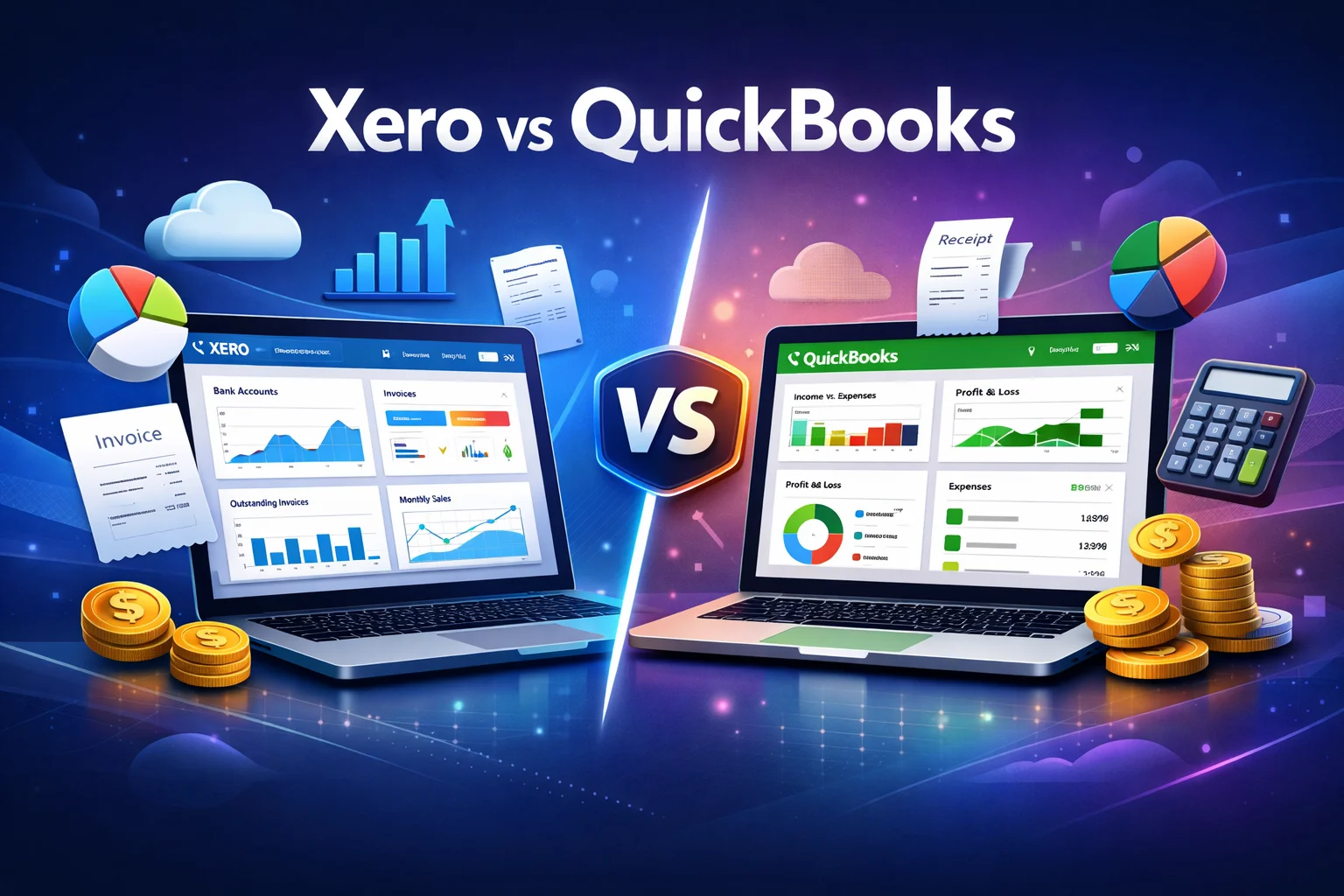
Xero vs QuickBooks: Which is Better for Small Businesses?
Choosing the right accounting software is one of the most important decisions for small business owners. Your choice impacts cash flow management, expense tracking, invoicing efficiency, tax compliance, and ultimately your ability to make informed financial decisions. Two of the most widely recommended cloud accounting platforms are Xero and QuickBooks Online — both trusted by millions of businesses worldwide.
But which is better for your small business?
In this comparison guide, we’ll take a deep, unbiased look at Xero vs QuickBooks Online — including features, pricing, ease of use, automation, integrations, reporting, support, and real‑world performance — so you can make a confident choice tailored to your business needs.
Overview: Xero and QuickBooks Online
What Is Xero?
Xero is a cloud‑based accounting platform designed for small and growing businesses. It emphasizes collaboration (especially with accountants), unlimited users, and a rich ecosystem of integrations.
Xero is known for:
- Unlimited users on every plan
- Strong bank reconciliation tools
- Clean, intuitive interface
- Excellent app ecosystem
What Is QuickBooks Online?
QuickBooks Online (by Intuit) is another leading cloud accounting solution used by millions of businesses. QuickBooks is especially popular in the United States and has long been regarded as the “industry standard” for small business accounting.
QuickBooks Online is known for:
- Excellent reporting tools
- Strong payroll integration
- Large ecosystem and third‑party support
- Deep tax and compliance features
Feature Comparison: Xero vs QuickBooks Online
To compare these platforms clearly, let’s break down how they stack up feature‑by‑feature.
| Feature | Xero | QuickBooks Online |
|---|---|---|
| Cloud‑Based | ✔ | ✔ |
| Unlimited Users | ✔ | ✘ (limits on most plans) |
| Invoicing | ✔ | ✔ |
| Bank Reconciliation | ✔ | ✔ |
| Multi‑Currency | ✔ (All plans) | Available (higher plans) |
| Project Tracking | ✔ | ✔ |
| Inventory Management | ✔ | ✔ |
| Payroll Integration | Partner add‑ons | Built‑in (in many regions) |
| Reporting | Good | Excellent |
| App Integrations | ~1,000+ | ~750+ |
| Mobile App | ✔ | ✔ |
| Best For | Collaborative teams / global businesses | U.S. tax and payroll focus |
Pricing Comparison
Pricing should be a key consideration for small businesses. Here’s an updated snapshot of typical pricing tiers in the U.S. market:
| Plan | Xero Monthly | QuickBooks Online Monthly | Notable Differences |
|---|---|---|---|
| Entry Level | ~$25 | ~$30 (Simple Start) | QuickBooks includes more tax support; Xero includes unlimited users |
| Mid Level | ~$55 | ~$60 (Plus) | Plus adds inventory & project tracking on both platforms |
| Advanced | ~$90 | ~$120 (Advanced) | QuickBooks Advanced is more expensive but offers more reporting |
Key Takeaways:
- Xero tends to be slightly cheaper for comparable tiers.
- QuickBooks Online Advanced is positioned for businesses needing deeper reporting and custom user permissions.
- Unlimited users in Xero adds value, especially for teams and accountants.
💡 Pro Tip: Always check for promotional offers — both platforms often provide discounted rates for new users.
Invoicing & Payment Capabilities
Accurate and flexible invoicing is critical for cash flow.
Xero Invoicing
✔ Customizable invoice templates
✔ Automated recurring invoices
✔ Online payments via Stripe, PayPal, Square, GoCardless
✔ Auto reminders for overdue payments
QuickBooks Invoicing
✔ Custom invoices with templates
✔ Recurring invoices and reminders
✔ In‑app payments (credit card, ACH)
✔ Integrated late fees and payment tracking
Winner: Tie
Both platforms offer robust invoicing and payment processing. QuickBooks integrates deeply with payment processing, while Xero offers flexibility across multiple gateways.
Bank Reconciliation & Expense Tracking
Bank reconciliation automates matching bank transactions to your books.
Xero
✔ Automatic bank feeds
✔ Bank rules for auto‑categorization
✔ Simple matching and reconciliation screens
QuickBooks Online
✔ Automatic bank feeds
✔ Smart categorization suggestions
✔ Seamless matching with invoicing and expenses
Winner: QuickBooks Online
Although both systems handle reconciliation well, QuickBooks’ automated categorization and machine learning suggestions are often rated slightly more intuitive.
Reporting & Financial Insights
Small business owners need accurate and clear reporting to make informed decisions.
Xero Reporting
✔ Profit & Loss
✔ Balance Sheet
✔ Cash Flow
✔ Aged Receivables / Payables
✔ Customizable dashboards
QuickBooks Online Reporting
✔ Profit & Loss
✔ Balance Sheet
✔ Cash Flow
✔ Aged Receivables / Payables
✔ Budgeting Tools
✔ Industry‑specific reports
✔ Project profitability reports
Winner: QuickBooks Online
QuickBooks’ reporting is often considered deeper and more customizable, especially for users who need advanced financial insights or industry‑specific report templates.
Multi‑Currency & International Support
For businesses with international clients or cross‑border operations, multi‑currency support is important.
Xero
✔ Multi‑currency on all plans
✔ Real‑time exchange rates
✔ Auto‑revaluation features
QuickBooks Online
✔ Multi‑currency available on select plans
✔ Manual rate updates possible
Winner: Xero
Xero’s multi‑currency support is both easier to use and included across most plans, making it more appealing for global businesses.
Inventory & Project Tracking
Inventory Management
Both Xero and QuickBooks offer inventory tracking, but handling is slightly different:
Xero
✔ Integrated inventory tracking
✔ Item details and stock levels
✔ Supports purchase orders and sales
QuickBooks Online
✔ Inventory support via Plus and Advanced plans
✔ In‑depth tracking and stock valuation
Project Tracking
Xero Projects allows time and cost tracking at the project level.
QuickBooks Projects provides profitability insights and job costing.
Winner: QuickBooks Online
While both systems support inventory and project tracking, QuickBooks tends to provide deeper built‑in insights, especially in comprehensive reporting.
Payroll & Tax Support
For businesses that handle payroll internally, this can be a deciding factor.
Xero
✔ Payroll via partnered apps (Gusto in the U.S.)
✔ Core payroll functionality with partner integrations
✔ Requires extra subscription in some regions
QuickBooks Online
✔ Native payroll integration (full‑featured in the U.S.)
✔ Employee tax filings and payroll reporting
✔ Time tracking integration built into ecosystem
Winner: QuickBooks Online
QuickBooks has an edge for payroll and tax compliance, especially in the U.S. where it’s designed to work seamlessly with federal and state tax forms.
Mobile Experience
Both platforms offer mobile apps.
Xero Mobile App
✔ Create invoices on the go
✔ Capture receipts
✔ Reconcile transactions
✔ View dashboards
QuickBooks Mobile App
✔ Invoicing and payments
✔ Receipt capture
✔ Expense tracking
✔ Reporting summaries
Winner: Tie
Feature sets are similar, and both apps receive regular updates.
User Experience & Learning Curve
Xero
✔ Clean and modern interface
✔ Intuitive workflows
✔ Designed for collaboration
QuickBooks Online
✔ Feature‑rich interface
✔ Slight learning curve for advanced features
✔ Extensive help documentation
Winner: Xero
While both platforms are user‑friendly, Xero’s interface is often described as more intuitive for beginners, especially non‑accountants.
Supported Integrations & Ecosystem
Wide integration support ensures the platform connects smoothly with tools you already use.
| Type | Xero Integrations | QuickBooks Integrations |
|---|---|---|
| Payment Gateways | Stripe, PayPal, Square | Intuit Payments, PayPal |
| CRM Systems | HubSpot, Salesforce | HubSpot, Salesforce |
| Payroll Partners | Gusto, Zenefits | Built‑in + partners |
| Ecommerce | Shopify, WooCommerce | Shopify, BigCommerce |
| Reporting & BI | Fathom, Spotlight | Fathom, Qvinci |
Winner: Xero
Xero supports over 1,000 third‑party integrations, offering slightly broader ecosystem compatibility.
Support & Training Resources
Good support and learning materials are essential, especially for small business owners wearing multiple hats.
Xero
✔ Online help center
✔ Community forums
✔ In‑software tips
✔ Webinars and training partners
QuickBooks Online
✔ Expert support
✔ Extensive documentation
✔ Tutorials, webinars, and QuickBooks Academy
✔ Large partner ecosystem
Winner: QuickBooks Online
QuickBooks often scores higher in support options due to its larger user base, certified experts, and detailed training materials.
Security & Data Protection
Both platforms use industry‑standard security measures with data encryption, secure servers, and regular backups.
✔ SSL encryption
✔ Multi‑factor authentication
✔ Cloud backups
✔ Data center compliance
Winner: Tie
Both platforms are secure and built for cloud accounting.
Who Should Choose Which?
Here’s a simple decision matrix based on business needs:
Choose Xero If:
✔ You want unlimited user access without extra cost
✔ You operate internationally with multi‑currency needs
✔ You prefer a modern and intuitive interface
✔ You need broad third‑party integrations
Choose QuickBooks Online If:
✔ You need powerful reporting and deeper financial insights
✔ Payroll and tax filing are priorities
✔ You want robust inventory and project reporting
✔ You operate primarily in the U.S. and want native payroll support
Real‑World Scenarios
Scenario 1: A Small Retail Business
Jane runs a boutique retail store that needs inventory tracking, sales reporting, and bank reconciliation.
Best choice: QuickBooks Online Plus, thanks to strong inventory, tax, and reporting tools.
Scenario 2: A Freelance Consultant
Carlos is a freelance consultant sending invoices monthly and working with an external accountant.
Best choice: Xero Growing, for unlimited users, easy invoicing, and collaborative features.
Scenario 3: A Global Agency
A marketing agency with international clients and multi‑currency billing needs.
Best choice: Xero Established, due to multi‑currency support and collaboration tools with global accountants.
Final Verdict
Both Xero and QuickBooks Online are excellent accounting platforms that serve small businesses extremely well. The “better” choice depends on your priorities:
- Xero excels in collaboration, multi‑currency, integrations, and a streamlined UX.
- QuickBooks Online leads in advanced reporting, payroll integration, and comprehensive financial insights.
If you value ease of use and flexible integration, Xero may be right for you. If you require in‑depth financial reporting and payroll support, especially within the U.S., QuickBooks Online might be the better fit.
Ultimately, your business’s workflow, growth plans, and country of operation will influence the best choice.
Frequently Asked Questions (FAQs)
1. Is Xero better than QuickBooks for small businesses?
It depends on your needs. Xero is strong in usability and integrations, while QuickBooks offers deeper reporting and payroll tools.
2. Are Xero and QuickBooks both cloud‑based?
Yes — both platforms are cloud‑based and accessible from anywhere with an internet connection.
3. Can I switch between Xero and QuickBooks?
Yes, but it requires careful data migration and planning to ensure accuracy.
4. Which is more affordable?
Pricing varies by plan tier, but Xero tends to be slightly more cost‑effective at entry and mid plans.
5. Do both platforms support mobile apps?
Yes, both Xero and QuickBooks have fully featured mobile apps for invoicing, reconciliation, and expense tracking.